
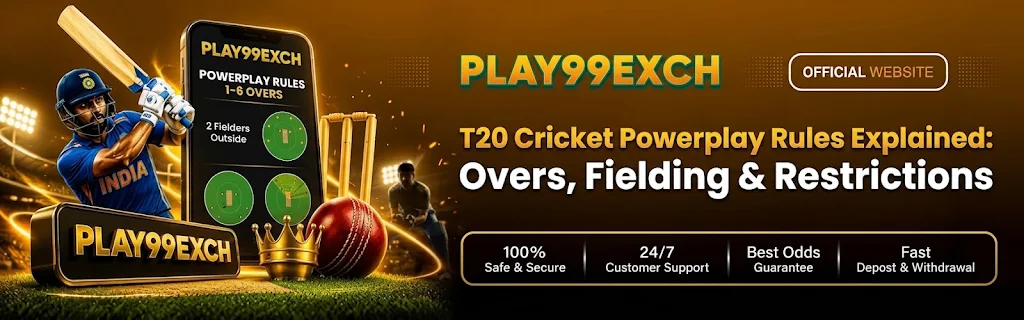
Powerplay is an important portion of a T20 game. Fielding limits throughout the first six overs allow the hitters an opportunity to strike as the bowlers try to claim early wickets. By understanding T20 Cricket Powerplay Rules Explained, spectators may properly understand the team plans.
In simple words, power play rules in T20 cricket restrict the number of fielders who can be outside the 30-yard circle. This leaves holes in the outfield and encourages attacking, hitting early in the innings.
Fans of the game watch the matches on digital platforms, live scores and highlights. Some readers may see services like Play99 Exchange, but any cricket-related platform should be reviewed for terms, security and local legal requirements before use.
What is Powerplay in T20 Cricket?
A powerplay is a period of time at the beginning of an innings with fielding restrictions. A T20 International consists of the opening six overs of an innings.
In Power play rules in T20 cricket regulations make for a clear confrontation between hitters looking for boundaries and bowlers looking for wickets.
The play99win app is found by users of the mobile cricket service, however only apps from verified sources should be downloaded.
T20 Cricket Powerplay Rules Explained: Overs and Duration
T20 Cricket Powerplay Rules Explained The first thing you need to know about the powerplay is that in a complete 20-over T20 International innings it lasts for the first six overs.
Ends after the sixth over. From the seventh on the field can spread out. During the powerplay, two fielders can be outside the 30-yard circle; after that five can be.
These rules relate to ICC men’s T20I playing conditions. Domestic leagues may vary.
Thus, in Power play rules in T20 cricket regulations are only applicable in the initial phase of each innings.
A play99exch ID is an account identification and should be used with caution. Individuals should verify the verification standards, privacy policies, and local laws before registering for or using any online cricket-related account.
Powerplay Fielding Rules in T20
The 30-yard circle is the basis of the powerplay fielding rules in T20. This circle is made up of two semi-circles, whose centres are the middle stumps at either end, linked by straight lines.
There cannot be more than two fielders outside the 30-yard circle at the time of delivery throughout the first six overs.
In T20 cricket, the power play regulations encourage attacking strokes and provide bowlers an opportunity to pick more wickets.
If there are more than two fielders outside the circle on a powerplay delivery the delivery could be deemed a no-ball under the applicable playing conditions. It is a free hit next ball in T20 Internationals.
T20 Cricket Powerplay Rules Explained make the fielding restriction easy to understand: fewer fielders outside implies greater spaces for hitters.
If you want to visit a cricket related platform securely then you should only utilise an official pay 99 login page accessed through a verified link. Never submit passwords, OTPs or banking details on an unknown website.
Powerplay Rules in ODI cricket
In ODI cricket the powerplay rules are different, as one entire ODI innings is 50 overs long. The ICC identifies three stages of fielding restrictions in an innings.
In a full men’s ODI, Powerplay 1 is overs 1 to 10, with no more than two fielders outside the 30-yard circle. Powerplay 2 is 11-40 overs and a maximum of four outside. Powerplay 3 covers overs 41 to 50 and allows five outside.
In T20, five fielders can be outside after the sixth over.
Thus, powerplay rules in ODI cricket vary more gradually over the course of the innings, while T20 limits are concentrated at the beginning.
T20 Cricket Powerplay Rules Explained also helps fans to evaluate the fielding restrictions between the two formats.
Those who want to get support or have queries relating to the platform can contact Play99exch through an official Play99exch Contact channel made available by the service. Do not provide personal or financial information with questionable contacts.
How Powerplays Affect Batting and Bowling Strategies
The field is up, so batters generally get on swiftly.
Powerplay rules in ODI cricket Spread limits throughout three stages. T20 plans to focus on the first six overs.
Captains place fielders within the allowed restrictions. During the powerplay, they must have nine fielders inside the circle, including the bowler and wicket-keeper, and only two outside.
T20 power play regulations add a tactical element, hitters target boundaries, bowlers target early wickets and economical overs.
T20 powerplay fielding regulations have an impact on bowling changes too. A skipper can pitch a strike bowler early and then put in a spinner or another seamer depending on the circumstances.
T20 Cricket Powerplay Rules Explained the opening 6 overs frequently dictate the rest of the contest.
Common Powerplay Rules and Misunderstandings
Many newcomers ask if a team may lose wickets in power play. “Wickets can fall at any stage, even in the first six overs.
“Another concern is whether one bowler can bowl all the six powerplay overs. In a T20 International, a bowler may toss up to four overs throughout a full 20-over innings. So no bowler can bowl all six.
If weather delays the contest, the duration of the powerplay could change. Under ICC men’s T20I playing circumstances, the powerplay for a reduced innings is computed to the nearest ball, not rounded to a full over.
Power play rules may vary in abbreviated T20 matches and spectators should check the current playing circumstances for that sport.
Power play rules in T20 cricket are subject to the current playing conditions of the specific competition and should constantly be examined, especially in rain-affected matches.
T20 powerplay fielding restrictions don’t stop wickets falling – they just limit where fielders may stand.
If you are a reader looking for services relating to cricket, then play99exchange is a phrase associated with the platform, which you should verify carefully.
FAQs
How many powerplay overs in T20 cricket?
In a complete 20-Over T20 International, the first six overs of each innings are known as the powerplay.
How many players can field outside the circle in a T20 powerplay?
At the moment of delivery, only two fielders may be outside the 30-yard circle.
What are power plays in ODI and T20?
In ODI cricket, Powerplay Rules have three phases over 50 overs but a T20 International has just one powerplay of six overs.
What is the importance of powerplay overs?
The T20 Cricket Powerplay Rules Explained explains how the early overs may make all the difference to the game by offering chances to score quickly or to get early wickets.
Are there changes to the powerplay rules in rain games?
Yes. T20 Powerplay Fielding Rules may be varied for abbreviated T20 Internationals with the length of the powerplay being varied in accordance with the applicable playing conditions.
Summary
T20 Cricket Powerplay Rules Explained can be summed up in three terms simply. The first six overs are called the powerplay, only two fielders can be outside the 30-yard circle and thereafter the limitations are eased.
Powerplay rules are different in ODI cricket as there are three fielding phases in a 50-over innings. Knowing the T20 cricket power play regulations and T20 powerplay fielding rules helps spectators understand the batting aggression, bowling strategies and captaincy decisions better.