
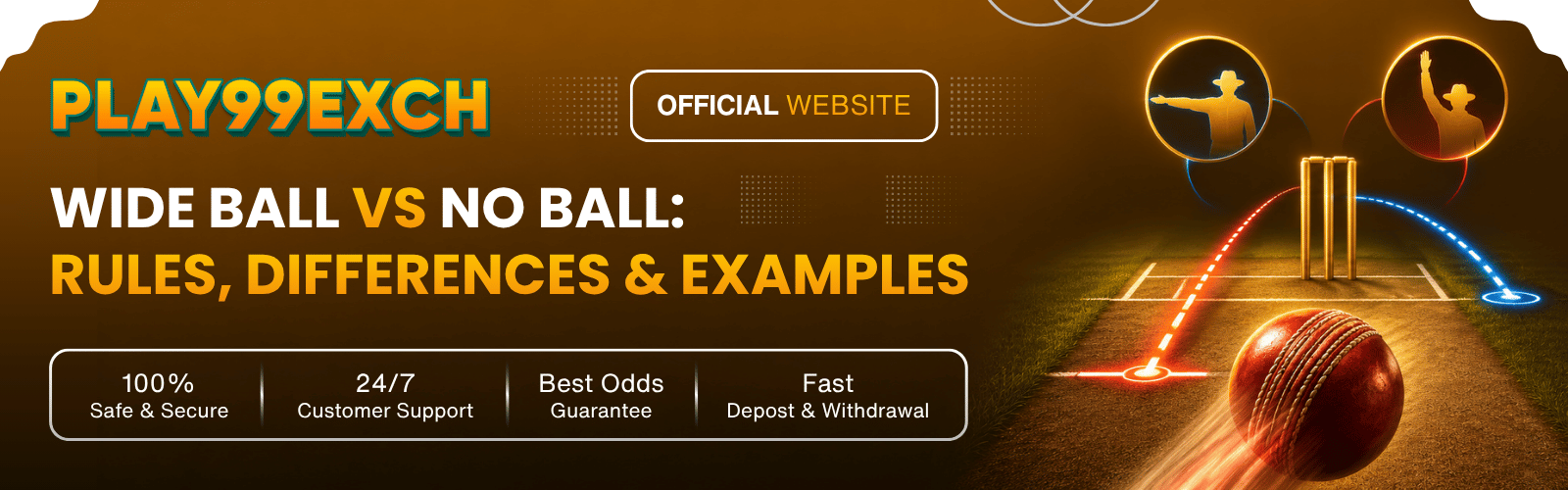
Picture this. The bowler runs in, the batter leaves it alone, and the umpire throws both arms out. Was that a wide or a no ball? Plenty of fans get confused here, and honestly, it is correct. Both are extras. Both add one run for the batting side. Both force the bowler to bowl the delivery again. But the reasons behind them are different, and so are the results. This simple guide on Wide Ball vs No Ball explains each rule in easy words, with small match examples you can picture. By the end, you will know what makes a ball wide, what makes it a no ball, how many runs get added, and when a batter can be out. Watching a Test, an IPL night game or gully cricket with friends? Does not matter. Let us sort it out.
What Is a Wide Ball in Cricket?
A wide is a ball that is too far from the batter to be played with a normal shot. The umpire looks at where the batter was standing when the ball left the bowler’s hand, not where the batter ended up.
Wide Ball Rules in Cricket
- The ball goes too far off the line, or too high over the batter’s head.
- The umpire stretches both arms out sideways.
- It is not a proper delivery, so the bowler bowls again.
- The batting team gets one run.
White-ball games are stricter, as the wide line is kept tighter to help batters. Many leagues and ICC events even allow a review of some Wide Ball Penalty.
When Is a Wide Not Given?
If the bat touches the ball, it is not wide. Same story if the batter walks far across the crease and makes a normal ball look wide.
What Is a No Ball in Cricket?
No Ball Rules in Cricket, refers to illegal bowling. There has been an anomaly in either the bowling action or the setting of the field; thus, the batting team earns one run while the ball will be bowled once more.
Rules of No-Ball in Cricket
- Front foot crosses the popping crease during the delivery.
- A delivery that passes above the waist of the batsman without bouncing.
- Bounce delivery limit exceeds the prescribed number in the format.
- Keeper moves ahead of the wickets.
- The fielding side breaks field restrictions, like too many fielders behind square on the leg side.
Overstepping is the number one reason. The front foot must land behind the popping crease, and even a small gap over the line counts. In many matches the third umpire checks this and informs the on-field umpire. To know more about the no balls and what each ball directions mean in cricket get the app and do the play99exch win login and understand each process clearly.
What Is a Free Hit in Cricket?
After a front-foot no ball in white-ball cricket, the next ball is a free hit. The batter cannot be out bowled, caught, LBW or stumped. Running out is the main danger.
Wide Ball vs No Ball: Key Differences
Here is the quick picture of Wide Ball vs No Ball side by side. The free hit is the biggest gap, because a wide never gives one.
| Delivery | What happened | Runs |
| Extra ball | Wide down the leg side | 1 |
| Ball 1 | Dot ball | 0 |
| Extra ball | No ball, hit for four | 5 |
| Ball 2 | Free hit, single taken | 1 |
| Extra ball | Wide, batters run one | 2 |
| Total | 9 |
Wide Ball vs No Ball Example Over
Here is a short over showing a wide and a no ball together.
| Point | Wide Ball | No Ball |
| Cause | Delivery is off line or too high | Illegal action or field setting |
| Umpire signal | Both arms out sideways | One arm out straight |
| Penalty | 1 run | 1 run |
| Legal ball? | No | No |
| Free hit next? | No | Yes, for overstepping in white-ball games |
| Batter can be out by | Run out, stumped, hit wicket | Mostly run out |
That is 9 runs, but only two legal balls are done. Four are still left in the over.
Can a Batter Be Out on a Wide or No Ball?
Yes, but only in some ways. On a wide, the batter can be run out, stumped or out hit wicket. On a No Ball Extra Runs,run out is the usual one. Bowled, caught and LBW are off the list for both. So even in the Wide Ball vs No Ball debate, this part looks quite similar.
Why These Rules Matter to Fans
Extras decide close games, especially in T20, where five or six extras can swing the result. Fans who follow live scores on play 99 see wides and no balls updated ball by ball. Every platform has its own rules on how extras are treated in different markets, so read those first. Knowing Wide Ball vs No Ball makes these updates much easier to read.
Follow Live Cricket Online
Mobile users can check the play 99 app for match updates. On desktop, website:play99exch.ing works in a browser. Use only the official site, and skip links that come from unknown messages.
Register and Login Steps
- Open the official website.
- Choose the Play99Exch Register option and fill in your details.
- Next time, use play 99 exch ogin to sign in.
- Returning users can also try from the same site.
Online betting rules differ across Indian states. Play only if it is allowed where you live, and only if you are 18 or above.
Conclusion
Now the Wide Ball vs No Ball puzzle is simple. A wide is about line and height. A No Ball Penalty is about an illegal delivery. Both give one run and both mean a re bowl, but only a front-foot no ball brings a free hit. Keep these small points in mind and every over will make more sense. Want to catch the next match with better understanding? If you are looking for live updates on cricket matches, check out play99 exchange,
FAQs
What’s the difference between Wide Ball vs No Ball?
A wide is a ball the batter cannot play and a no ball is an illegal delivery.
How many runs does a wide give?
One penalty run, plus any runs the batters take.
Is a free hit given after a wide?
No, it comes only after a no ball for overstepping in white-ball cricket.
Can a batter be bowled on a no ball?
No, bowled is not a valid dismissal on a no ball.
Does a wide count as a legal ball?
No, the bowler has to bowl it again.
Can a no ball be hit for six?
Yes, and the team then gets 7 runs in total.
Who checks front-foot no balls?
The on-field umpire decides, and in many matches the third umpire helps.